

Adult Growth Hormone Deficiency: Symptoms, Testing and What to Ask
Adult growth hormone deficiency is rare. Fatigue or a change in body composition may raise questions, but neither symptom proves GHD. This...
 Written by
Dr Ali Aldibbiat
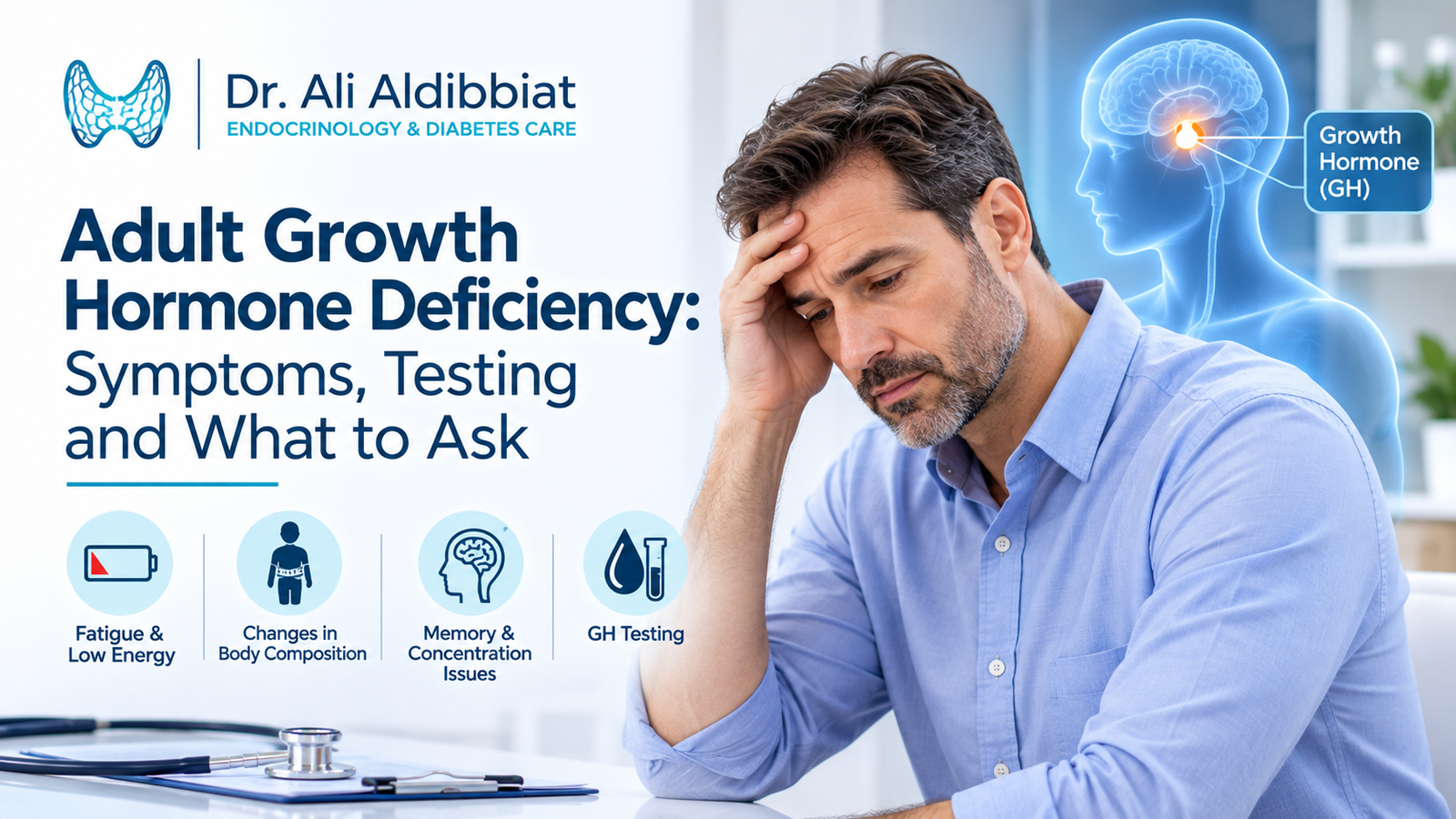
Adult growth hormone deficiency is rare. Fatigue or a change in body composition may raise questions, but neither symptom proves GHD. This guide explains possible clues, why testing is specialized, and how to prepare questions for an endocrinology appointment. Testing needs more than a symptom checklist. Symptoms cannot decide diagnosis.
Key Takeaways
- Adult GHD is uncommon and is assessed in the context of medical history, especially pituitary conditions.
- Fatigue and weight changes have many possible causes and cannot diagnose GHD.
- Diagnosis often requires specialist interpretation and, when indicated, stimulation testing.
- Bring relevant records and ask what each test can and cannot establish.
What growth hormone does in adults
Growth hormone is produced by the pituitary gland, a small gland at the base of the brain. In childhood it has a central role in growth; in adulthood it continues to affect metabolism and body composition.
The pituitary works with the hypothalamus and other hormone systems, so an adult hormone problem may arise alongside other pituitary deficiencies or after a condition affecting the brain or pituitary.
Adult GHD can persist from childhood or develop later in life, but it is considered uncommon. The Endocrine Society’s patient resource describes GHD as rare and explains that evaluation depends on the person’s history and clinical context.[1]
That context matters because fatigue, weight change, reduced exercise capacity, low mood, and changes in wellbeing are not unique to GHD.
Sleep problems, stress, medication effects, thyroid disorders, anemia, depression, changes in activity, and many other conditions can produce similar experiences. These symptoms deserve thoughtful attention, but they do not establish that growth hormone is low.
A person should not infer a deficiency from a symptom checklist or use a commercial test as a replacement for a medical evaluation.
For a broader view of hormonal health, the clinic’s page on endocrinology care provides related reading. It is not evidence that a reader has GHD, and a webpage cannot assess an individual’s hormone status.
Who may be assessed for adult GHD?
Clinicians are more likely to consider adult GHD when there is a relevant medical history.
Examples can include a pituitary or hypothalamic tumor, surgery or radiation involving that region, a known genetic or structural condition, traumatic brain injury, or a history of multiple pituitary hormone deficiencies.
Some adults were diagnosed with GHD in childhood and need a transition assessment to determine whether the condition continues. These examples identify contexts for a discussion; they do not mean that every person with one of these histories has GHD.
The probability of GHD depends on the cause, the number and nature of other hormone deficiencies, the results of prior evaluations, and the overall clinical picture.
A clinician reviews records and current health rather than relying on one symptom or a single screening value. If you have undergone pituitary surgery, radiation, or imaging, bring available reports and a list of medicines to the appointment.
Do not stop or change prescribed treatment while preparing for a consultation.
Growth hormone is only one part of a larger endocrine system. A thyroid condition, diabetes, or another hormone issue may contribute to symptoms and may need separate assessment.
The clinic’s diabetes guide discusses another condition that can affect wellbeing, but it cannot determine whether GHD is present. The goal is to identify the right explanation, not to label every nonspecific symptom as hormonal.
What symptoms can adult growth hormone deficiency cause?
Adults with confirmed GHD may report changes in body composition, reduced exercise capacity, low energy, or poorer quality of life. Some may also have changes in bone health or cardiovascular risk factors.
These features are not unique to GHD, and their presence does not tell a person whether growth hormone secretion is deficient. They must be interpreted in the setting of a medical history, examination, and the results of appropriate testing.
A symptom can be real and important even when it ultimately has a different cause.
Weight gain or difficulty losing weight is not a stand-alone sign of GHD. Nor does feeling tired after work or exercising prove that hormone levels are abnormal.
A common error is to match a general symptom to a hormone condition and then treat the match as a diagnosis. The opposite error is also unhelpful: assuming symptoms are unimportant because they are nonspecific.
A clinician can assess the symptom while considering more common and potentially treatable explanations alongside rare ones.
Adults may have more than one pituitary hormone issue, and these can overlap in how they affect energy and health.
A full history can include menstrual or sexual health, changes in thirst or urination, headaches or visual changes, medication use, and prior endocrine diagnoses where relevant.
These details help guide evaluation but should be shared privately with the clinician, not used to self-diagnose.
If you are tracking symptoms, note when they began, how they change, and what affects them instead of relying on a broad checklist.
Why diagnosis is not a simple blood test
Growth hormone is released in pulses rather than at a constant level throughout the day. A random blood growth hormone measurement can therefore be difficult to interpret and is not, by itself, a reliable way to confirm adult GHD.
Insulin-like growth factor 1 (IGF-1) is often measured as part of assessment, but an IGF-1 result must also be interpreted in context.
A normal value does not exclude every case, and a low value does not independently establish the diagnosis.
For many adults, diagnosis requires a stimulation test, which evaluates how growth hormone responds after a supervised stimulus. The exact test and interpretation depend on the person, the suspected cause, other health conditions, and local practice.
The Endocrine Society clinical practice guideline explains that confirmation through stimulation testing is usually required, with specific exceptions for certain well-established histories.[2]
A test result is assessed against criteria appropriate to the method and patient rather than a universal number taken from an online post.
Testing can be more complex when a person has obesity, diabetes, other pituitary deficiencies, or conditions that influence test interpretation.
Some tests require preparation or supervision, and the clinician needs to review whether a test is suitable before it is arranged. It is not safe to attempt a test or hormone challenge independently.
Ask who will explain the procedure, what preparation is required, how long the visit may take, and when you can expect an interpretation.
| Assessment step | What it may contribute | Important limitation |
|---|---|---|
| Medical history and records | Shows whether there is a relevant pituitary or hypothalamic context. | History alone may not confirm current GHD. |
| IGF-1 blood test | Adds information about the growth hormone axis. | It must be interpreted in context; one value does not settle every case. |
| Stimulation testing | Measures growth hormone response after a supervised stimulus. | Choice and interpretation depend on the person and test method. |
Recent international discussion also reflects ongoing questions about diagnostic criteria and the choice of biochemical tests. A 2025 GH Research Society Delphi review addresses areas of consensus as well as continuing controversies in diagnosis.[3]
This is a reason to use specialist interpretation—not a reason to distrust testing or to choose a test based on a social-media post. The relevant method depends on the person’s history and clinical setting.
What changed in adult GHD diagnosis guidance recently?
A 2025 GH Research Society Delphi review mapped areas of agreement and continuing controversy in biochemical testing and diagnostic criteria.[3]
Its publication does not create one universal test for every adult; it highlights why results should be interpreted by clinicians familiar with the person’s history and the method used.
The Endocrine Society’s clinical practice guideline remains a key reference for evaluating adult GHD and explains why stimulation testing is usually needed, subject to specific clinical exceptions.[2] No newer universal replacement guideline was verified for this draft.
Ask the endocrinologist which current professional guidance informs the proposed assessment.
What happens during an endocrine assessment?
An appointment often begins with a detailed history and review of previous diagnoses, treatments, surgery, radiation, and relevant imaging. A clinician may ask about symptoms, their timing, medicines and supplements, and how daily function has changed.
They may review other pituitary hormones because deficiencies can occur together. Prior lab results are most helpful when the date, reference range, and reason for testing are available.
Bring the original report when possible, not only a remembered result or a cropped screenshot.
Physical examination and blood tests may help assess the wider endocrine picture. Further tests may be recommended only if the history supports them.
The work-up is not necessarily completed in one visit: records may need to be reviewed, testing arranged, and results discussed in a follow-up appointment.
This careful process reduces the risk of interpreting an isolated laboratory value as a complete answer.
There is no single symptom, questionnaire, or routine blood test that settles every case.
The Endotext clinical review on adult GHD likewise describes diagnosis as dependent on demonstrating an insufficient growth hormone response to appropriate testing, interpreted within the clinical context.[4]
If you are referred for a stimulation study, ask what question the test is intended to answer and how the result will affect the next decision.
For an appointment, prepare a concise timeline: when symptoms began, whether they are stable or changing, and any pituitary-related history. List prescription medicines, over-the-counter products, and supplements.
If you use glucose monitoring or have diabetes, mention it because health conditions can be relevant to the choice and interpretation of tests.
The clinic’s continuous glucose monitoring guide is related reading, not a substitute for individual advice about endocrine testing.
Questions to ask about results
Ask what each test measures and whether it is a screening step or a confirmatory test.
If a result is outside its reference range, ask whether the finding can be affected by age, illness, medicines, sleep, nutrition, or another hormone condition. Find out whether the result fits the history and whether additional testing is needed.
A laboratory value should not be interpreted without considering how and why it was obtained.
If a stimulation test is recommended, ask about preparation, possible side effects, monitoring, and how the clinician will account for other conditions.
Ask when and how results will be reviewed, and who to contact if the report arrives before a follow-up visit. These questions help you understand the process without trying to interpret a complex result on your own.
It is also reasonable to ask what alternative explanations are being considered and whether any other pituitary or endocrine testing is appropriate. A diagnosis should be connected to evidence and a clear clinical rationale.
If the explanation is unclear, request that the clinician distinguish what is known, what remains uncertain, and what would change the assessment.
Discussing treatment without assuming it is needed
A diagnosis does not automatically mean that one treatment is right for everyone. Decisions are individualized and involve weighing potential benefits, risks, medical history, and personal priorities.
The Endocrine Society guideline emphasizes clinical judgment and individual assessment when considering treatment.[2] This article does not provide treatment recommendations, dosing, or a way to decide whether a person should receive growth hormone.
Be cautious of online claims that promise a particular body shape, rapid weight loss, improved athletic performance, or a universal “anti-aging” effect. Promotional language cannot establish a diagnosis or predict an individual outcome.
If a treatment is discussed, ask what evidence supports it for your confirmed condition, how benefit and safety would be monitored, and what alternatives exist. Only the treating clinician can apply that discussion to your health.
Do not use a product marketed as “HGH,” “growth hormone support,” or a supplement as a substitute for evaluation. Products sold online may not contain what a buyer expects, and non-prescribed hormone use can carry significant risk.
The distinction between a regulated prescription treatment and a product promoted with hormone-related claims matters. Consult a qualified health professional before taking a product that may affect hormones or interact with medicines.
Separating online searches from medical evidence
Searches for “growth hormone Dubai,” “HGH Dubai,” or treatment prices often lead to advertisements and commercial pages. Such search results do not confirm a diagnosis, prove that a service is suitable, or establish that a specific test is needed.
A treatment price cannot tell you whether GHD is present or whether a particular clinical pathway is appropriate. The first question is whether a medically supported diagnosis exists, not which product or service to buy.
Professional guidelines and peer-reviewed endocrine references are more appropriate for learning about diagnosis than promotional pages. The Endocrine Society patient resource, clinical guideline, and Endotext review are useful starting points, but they do not replace a specialist’s evaluation.
The clinic’s endocrine care information can help readers locate the relevant practice, while the article on male hormonal health covers a separate topic. No service or outcome is promised by linking to these pages.
When to seek prompt care
Most nonspecific symptoms such as tiredness or gradual weight change are not an emergency, but some new symptoms need prompt assessment for reasons unrelated to GHD.
A sudden severe headache, new loss or blurring of vision, confusion, fainting, or rapidly worsening symptoms should be assessed urgently.
If you already have a pituitary condition and develop a new severe symptom, follow the urgent-care plan given by your clinical team. Do not wait for a routine hormone appointment when symptoms are acute or severe.
For ongoing concerns, arrange a routine visit and bring your records. A measured assessment can address common explanations as well as less common pituitary conditions.
The aim is not to find a growth hormone label for every change in energy or weight; it is to identify what the evidence supports and what next step, if any, is useful.
Frequently Asked Questions About Adult Growth Hormone Deficiency
Is adult growth hormone deficiency common?
No. Adult GHD is considered rare. The likelihood depends partly on medical history, including conditions that affect the pituitary or hypothalamus. A symptom such as fatigue cannot establish the diagnosis, and an endocrinologist considers the full clinical picture before deciding whether testing is appropriate.
Does fatigue mean my growth hormone is low?
No. Fatigue can have many causes, including sleep problems, stress, medication effects, anemia, and other medical conditions. It is worth discussing if persistent, but it does not prove a hormone deficiency. A clinician can assess the symptom while considering common explanations and relevant medical history.
Can one blood test diagnose adult GHD?
Usually not. Growth hormone is released in pulses, so a random measurement may be hard to interpret. IGF-1 can contribute information but also needs context. Diagnosis commonly requires specialist interpretation and, when indicated, supervised stimulation testing using criteria appropriate to the test and patient.
Should I take an online “HGH” product while I wait?
Do not self-treat a suspected deficiency with a product sold online. Promotional claims cannot establish GHD or show that a product is appropriate for you. Discuss medicines and supplements with a qualified clinician, especially if you have other conditions or take regular medication.
Resources and Further Reading
References
- The Endocrine Society. “Growth Hormone Deficiency.” Patient resource on rarity and clinical context.
- Molitch ME, et al. “Evaluation and Treatment of Adult Growth Hormone Deficiency: An Endocrine Society Clinical Practice Guideline.” JCEM. 2011;96(6):1587–1609. Summary and DOI.
- Arlien-Søborg MC, et al. “Consensus and controversies about diagnosing GH deficiency: a Delphi survey by the GH Research Society.” Pituitary. 2025;28(3):57. Diagnostic consensus and open questions.
- Monson JP, Brooke AM, Akker S. “Adult Growth Hormone Deficiency.” Endotext. 2015. Clinical reference on evaluation.
Conclusion
Adult growth hormone deficiency is rare, and common symptoms alone do not establish it. Assessment relies on clinical context and appropriately interpreted testing.
If you have a relevant pituitary history or persistent concerns, bring your records and ask an endocrinologist what evidence would support or rule out GHD.
Next Step
Prepare a list of symptoms, medicines, and prior pituitary tests, then discuss whether specialist assessment is warranted. Use the clinic website to find the appropriate contact route and ask what records to bring to an appointment.