

Insulin pump: Complete Clinical Guide to Smart Insulin Infusion
Clinically written and fact-checked by Dr. Ali Aldibbiat, Consultant Endocrinologist in Dubai, specializing in advanced diabetes technologies, automated insulin delivery systems, and...
 Written by
Dr Ali Aldibbiat
Clinically written and fact-checked by Dr. Ali Aldibbiat, Consultant Endocrinologist in Dubai, specializing in advanced diabetes technologies, automated insulin delivery systems, and complex metabolic disorders.
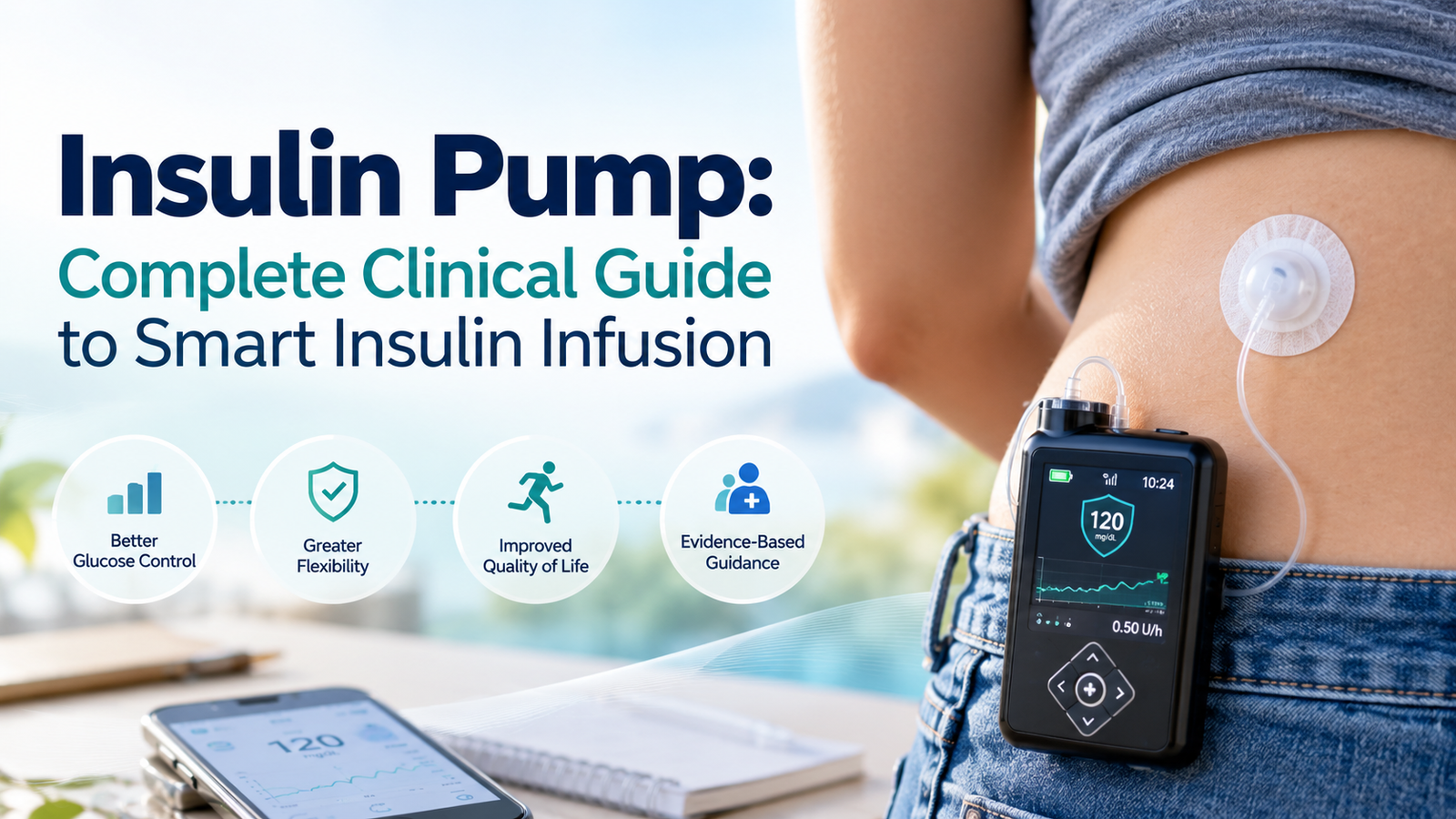
An insulin pump replaces repetitive daily injections with precise, continuous subcutaneous insulin delivery. This wearable medical device mimics healthy pancreatic beta-cell function, stabilizing blood glucose fluctuations day and night. For individuals managing diabetes, understanding device engineering, dosing algorithms, and practical wear makes the difference between persistent glycemic variability and sustained time-in-range. This clinical guide covers mechanics, candidate selection, and daily management.
Key Takeaways
- An insulin pump delivers rapid-acting insulin 24 hours a day through programmed basal rates and mealtime boluses, closely mirroring natural physiology.
- Automated Insulin Delivery (AID) systems pair an insulin pump with continuous glucose monitoring to adjust basal delivery in real time.
- Therapy options include traditional tethered infusion sets and tubeless wearable patch pumps, each offering distinct lifestyle trade-offs.
- Candidates include individuals with type 1 diabetes, insulin-requiring type 2 diabetes, marked dawn phenomenon, or severe hypoglycemia unawareness.
- Safe operation requires structured site rotation, backup supplies, and strict troubleshooting protocols to prevent rapid-onset diabetic ketoacidosis.
What Is an Insulin Pump and How Does Continuous Subcutaneous Insulin Infusion Work?
Continuous Subcutaneous Insulin Infusion (CSII), which means delivering micro-doses of rapid-acting medication through a tiny tube into the fat layer under your skin, is the core mechanism of pump therapy. This automated hardware eliminates the need for long-acting basal injections.
The mechanical architecture consists of three core components:
- Pump Reservoir: A cartridge holding between 180 and 300 units of rapid-acting U-100 or U-200 insulin.
- Pumping Mechanism: A micro-motor driven by precision software that pushes the cartridge plunger in increments as tiny as 0.025 units.
- Infusion Assembly: A flexible cannula inserted under the skin, linked directly or via thin plastic tubing to the device.
Regulatory frameworks documented by the U.S. Food and Drug Administration (FDA) categorize these platforms as Class II durable medical equipment with programmable dosing limits.
How Basal Rates and Bolus Doses Mimic Pancreatic Function
A healthy pancreas secretes tiny amounts of insulin continuously to balance hepatic glucose output, alongside sharp surges during meals.
Modern infusion devices recreate this dual-action profile using only rapid-acting analogues:
- Basal Profile: Micro-doses delivered every few minutes around the clock to maintain fasting stability.
- Nutritional Bolus: Larger user-activated doses administered immediately before eating carbohydrates.
- Correction Bolus: Supplemental doses calculated to reduce unexpected hyperglycemia back to target range.
What Happens If an Insulin Pump Cannula Bends Under My Skin?
Cannula crimping or kinking stops insulin delivery beneath the dermis, triggering sudden and unexplained hyperglycemia.
Because continuous infusion systems use zero long-acting basal depot, circulating insulin depletes within two to four hours of an interruption.
Patients who suspect an occlusion, which means a mechanical blockage that prevents insulin from flowing out of the tube, should verify ketones, administer a correction dose via syringe, and immediately replace the infusion set.
Insulin Pump vs Multiple Daily Injections: Clinical Advantages and Trade-offs
Selecting between an automated delivery system and multiple daily injections (MDI) requires balancing clinical precision against continuous hardware attachment.
MDI protocols require at least one long-acting injection alongside mealtime injections, totalling four to six skin punctures daily.
Comparative clinical trials published in the National Library of Medicine (PMC) show continuous infusion substantially reduces glycemic variability while lowering overall daily insulin requirements.
| Clinical Feature | Multiple Daily Injections (MDI) | Standard Insulin Pump (CSII) | Automated Insulin Delivery (AID) |
|---|---|---|---|
| Daily Skin Punctures | 4 to 6 manual needle sticks daily | 1 cannula insertion every 2 to 3 days | 1 cannula insertion every 2 to 3 days |
| Basal Flexibility | Fixed 24-hour absorption curves | Variable hour-by-hour programming | Dynamic algorithmic basal modulation |
| Hypoglycemia Protection | Passive; relies on food and alerts | Manual temporary basal reduction | Automated predictive suspend features |
| Equipment Burden | Discreet pens carried in bags | Device worn on body continuously | Device and sensor worn continuously |
| DKA Risk on Failure | Low; long-acting depot remains active | High if disconnected > 3 hours | High if disconnected > 3 hours |
Exploring a transition to smart delivery starts with a consultant-led diabetes management clinic in Dubai to evaluate metabolic stability and personal readiness.
Types of Insulin Pumps: Traditional Tubed Pumps vs Tubeless Patch Pumps
Modern hardware falls into two main physical form factors: tethered systems with tubing, and integrated tubeless patch pumps.
Both models deliver precision micro-dosing, but they interact differently with clothing, physical movement, and personal routines.
| Evaluation Factor | Traditional Tubed Insulin Pump | Tubeless Patch Insulin Pump |
|---|---|---|
| Anatomic Connection | Flexible tubing (60 cm to 110 cm) connects pump to site | Direct skin adhesion; zero external tubing |
| Controller Interface | On-pump buttons and screen, plus smartphone apps | Dedicated wireless handset or mobile smartphone |
| Reservoir Capacity | Up to 300 units; supports higher insulin needs | Usually capped at 200 units maximum |
| Temporary Detachment | Easily unclipped for contact sports, showers, or intimacy | Cannot be unclipped; pod stays attached or gets replaced |
| Snagging Risk | Tubing can catch on door handles or clothing | Zero external snag hazard; smooth profile |
How Does It Feel to Sleep with an Infusion Device Attached?
New users often worry about rolling onto their infusion hardware during sleep or dislodging the site.
Tubed units can be clipped to pajamas, tucked inside a pillowcase pocket, or allowed to rest freely on the mattress.
Patch pumps adhere directly against the flank, abdomen, or upper arm, staying secure beneath normal nightwear.
The Evolution to Automated Insulin Delivery: 2026 Standards of Care
The standard of modern diabetes technology is the Automated Insulin Delivery (AID) system, also called a hybrid closed-loop.
These configurations communicate directly with a continuous glucose sensor, automatically increasing or halting basal delivery based on predicted glucose trends.
Clinical guidelines outlined by the American Diabetes Association (ADA) Standards of Care recommend offering AID systems early after diagnosis rather than delaying until complications occur.
Patients pairing hardware should read our comprehensive continuous glucose monitoring patient guide to understand interstitial sensor dynamics, which means measuring glucose in the fluid between body cells rather than directly inside the bloodstream.
What Changed in Automated Insulin Delivery for 2026?
Clinical indications for automated infusion devices expanded materially in recent practice updates:
- Early AID Initiation: Removed rigid waiting periods or restrictive C-peptide laboratory cutoffs.
- Type 2 Diabetes Expansion: Formal clinical trial validation for insulin-requiring type 2 diabetes.
- Pregnancy Validation: Expanded safety clearances for target glucose control during pregnancy.
- Fully Interoperable Platforms: Secure connectivity between third-party sensors and pump hardware.
Who Is an Ideal Candidate for an Insulin Pump?
Candidacy depends on clinical need, personal motivation, and safety literacy rather than diabetes subtype alone.
Patients requiring intensive insulin therapy benefit most when standard injections fail to maintain target range without excessive hypoglycemia.
Type 1 Diabetes Management
Patients with unstable type 1 diabetes often face severe glycemic variability despite diligent carb counting.
Adopting continuous subcutaneous delivery allows hourly adjustments for exercise, hormonal shifts, and erratic work schedules.
Those seeking individualized guidance can review our specialized type 1 diabetes management programs in Dubai.
Type 2 Diabetes and Severe Insulin Resistance
Patients with advanced type 2 diabetes on high-dose insulin often experience persistent postprandial glucose spikes.
High-capacity tubed units allow steady delivery of concentrated insulin without frequent large-volume injections.
Our endocrinology team designs advanced clinical type 2 diabetes management pathways that integrate pumps alongside modern metabolic therapies.
Overcoming the Dawn Phenomenon and Gastroparesis
Early morning hepatic glucose release driven by cortisol and growth hormone surges causes resistant morning spikes.
An insulin pump resolves this by delivering elevated basal rates between 03:00 and 07:00 automatically.
For individuals with delayed stomach emptying, known as gastroparesis, which means a condition where your stomach takes too long to digest food, specialized bolus shapes match late carbohydrate absorption curves perfectly.
Basal Rates, Bolus Types, and Precision Dosing Calculations
Fine-tuning continuous infusion relies on three essential mathematical parameters established alongside your endocrinologist:
- Basal Profile (units/hr): Micro-doses tailored to your circadian insulin sensitivity rhythms.
- Insulin-to-Carbohydrate Ratio (ICR): Grams of carbohydrate covered by one unit of rapid-acting insulin.
- Insulin Sensitivity Factor (ISF): The points (in mg/dL or mmol/L) one unit drops your blood glucose.
Bolus Delivery Profiles for Different Meal Compositions
Unlike standard syringe injections, programmable delivery systems allow customized bolus delivery curves:
- Standard Normal Bolus: Delivers the full dose immediately; ideal for low-fat, rapid-carbohydrate meals.
- Extended (Square-Wave) Bolus: Spreads insulin delivery evenly over two to six hours; ideal for high-fat dining.
- Dual-Wave (Multi-Wave) Bolus: Delivers a portion upfront and the remainder over several hours; ideal for pizza or mixed buffets.
Living with an Insulin Pump: Infusion Site Rotation and Daily Care
Consistent subcutaneous absorption requires healthy fatty tissue free from scar tissue and inflammation.
Wearing an infusion set too long leads to poor absorption, unpredictable blood glucose, and skin infections.
Preventing Lipohypertrophy and Insertion Site Trauma
Infusing medication into the same anatomical area repeatedly causes localized fatty lumps known as lipohypertrophy, which means thickened fatty deposits beneath the skin that interfere with medication absorption.
These rubbery deposits delay insulin absorption, causing unexplained post-meal spikes followed by late crashes.
- Rotate infusion sites systematically across the abdomen, upper buttocks, flanks, and outer thighs.
- Change standard Teflon cannulas every 48 to 72 hours without exception.
- Change specialized extended-wear infusion sets at the manufacturer-recommended 7-day mark.
- Space new insertion points at least two to three centimeters away from previous sites.
Troubleshooting, Occlusions, and Preventing Diabetic Ketoacidosis
Because wearable continuous devices infuse zero long-acting basal insulin, any hardware interruption triggers rapid metabolic decompensation.
Diabetic ketoacidosis (DKA) can develop within four to six hours if insulin flow ceases completely.
Health systems evaluating clinical safety emphasize the structured guidelines from the National Institute for Health and Care Excellence (NICE) regarding pump monitoring protocols.
| Clinical Scenario | Underlying Root Cause | Immediate Clinical Action Protocol |
|---|---|---|
| Unexplained Glucose > 250 mg/dL (13.9 mmol/L) | Kinked cannula, displaced set, or denatured insulin | Check ketones; deliver correction via manual pen; replace infusion set. |
| Frequent Occlusion Alarms | Hardware line blockage, bent needle, or crystallized insulin | Inspect tubing; prime new line; relocate cannula to alternative site. |
| Persistent Site Wetness / Insulin Smell | Cannula pulled out of subcutaneous fat layer (tunneling) | Discard set immediately; clean skin; insert fresh cannula elsewhere. |
| Sudden Pump Screen Failure / Dead Battery | Mechanical processor crash or battery terminal failure | Switch immediately to manual MDI backup protocol with basal pen. |
Climate, Travel, and Storage: Protecting Insulin in High Heat
Extreme environmental heat degrades insulin molecules quickly, turning clear solutions cloudy and reducing their potency.
In hot desert climates such as Dubai and the wider Gulf region, ambient outdoor temperatures easily surpass 40°C during summer.
Protecting Pump Reservoirs and Adhesives in Warm Weather
Exposure to intense heat breaks down peptide bonds within the pump reservoir while softening medical adhesive tapes:
- Avoid storing spare cartridges in hot vehicles, beach bags, or direct sunlight.
- Refill pump reservoirs with smaller volumes (e.g., two days of insulin) to minimize heat degradation.
- Apply medical antiperspirant or liquid barrier films under adhesives to counteract heavy sweating.
- Keep backup insulin pens inside insulated, evaporative cooling pouches during outdoor travel.
Will My Infusion Hardware Set Off Airport Security Scanners or Fail During Flights?
Aviation security scanners emit electromagnetic radiation that may interfere with pump motor calibration.
Cabin pressure shifts during rapid ascent can also cause micro-bubbles to expand inside the cartridge, infusing tiny excess doses.
- Never send an automated infusion device or continuous sensor through full-body X-ray scanners or luggage screening belts.
- Request a gentle visual inspection and manual hand-swab from airport security personnel.
- Disconnect the infusion set briefly during aircraft takeoff and landing to purge pressure bubbles.
- Always keep a doctor’s medical device travel certificate inside your carry-on luggage.
Frequently Asked Questions About Insulin Pump
How does an insulin pump work throughout the day and night?
An insulin pump continuously infuses small amounts of rapid-acting insulin into the subcutaneous fat layer. It delivers steady background basal rates every few minutes 24 hours a day. During meals, the user triggers an on-demand bolus dose to cover carbohydrate intake and manage postprandial glucose rises.
What are the primary benefits and disadvantages of an insulin pump?
Key benefits include superior glycemic stability, fewer needle injections, flexible meal timing, and customizable basal rates for sports. Disadvantages involve wearing hardware on your body continuously, the ongoing financial cost of specialized consumables, and an increased risk of rapid-onset diabetic ketoacidosis if the infusion line clogs.
Can someone with Type 2 diabetes benefit from an insulin pump?
Yes. Individuals with type 2 diabetes who require multiple daily injections or have pronounced insulin resistance can use an automated infusion system. Modern high-capacity systems deliver precise basal coverage, helping reduce severe glucose fluctuations while eliminating multiple daily injections and supporting overall metabolic health.
How often do you need to change an infusion set?
Standard Teflon and steel infusion sets must be replaced every 48 to 72 hours to prevent site inflammation and poor absorption. Specialized extended-wear infusion sets can stay in place for up to seven days. Rotating your infusion sites regularly prevents lipohypertrophy and preserves healthy subcutaneous tissue.
What should I do if my pump adhesive peels off in high humidity?
Clean your skin with an alcohol swab, let it dry completely, and apply a specialized liquid skin barrier before placing the adhesive. For active days in humid weather, reinforce the edges with breathable medical kinesiology tape or overlay patches to keep the cannula secure without irritating your skin.
Is an automated delivery device waterproof for swimming and beach activities?
Most tubeless patch devices are waterproof and can be worn while swimming at moderate depths. In contrast, traditional tubed hardware is typically water-resistant rather than waterproof. Users should unclip tubed models before swimming or bathing and reconnect them immediately afterward, monitoring their blood glucose levels closely.
How do you hide continuous hardware under formal or fitted clothing?
Tubed units can be hidden inside bra holsters, thigh bands, low-profile waist pouches, or dedicated pockets sewn into garments. Tubeless patch pumps offer a flat, low-profile design that sits discreetly beneath fitted shirts, formal evening wear, or traditional clothing without visible tubing or bulky outlines.
Resources and Further Reading
- National Institute for Health and Care Excellence (NICE): Evidence-based clinical guidelines and technology appraisals for continuous subcutaneous insulin infusion therapy.
- U.S. Food and Drug Administration (FDA): Safety advisories, performance standards, and interoperable automated glycemic controller guidelines for insulin infusion systems.
- National Library of Medicine (PMC): Clinical research comparing glycemic variability and patient-reported outcomes between CSII and multiple daily injections.
Grounding Sources
- [1] U.S. Food and Drug Administration (FDA)
- [2] National Library of Medicine (PMC)
- [3] National Institute for Health and Care Excellence (NICE)
Conclusion
Adopting an insulin pump transforms daily diabetes care by delivering physiologic micro-dosing and pairing with smart continuous glucose sensors. Successful therapy requires personalized device selection, rigorous carbohydrate counting, regular site rotation, and safe troubleshooting routines. When supported by expert clinical guidance, continuous insulin infusion provides steady glycemic stability and greater daily peace of mind.
Ready to Take the Next Step?
If you or a family member are considering pump therapy or looking to optimize an automated insulin delivery system, expert clinical support is essential. Our team provides comprehensive evaluations, device onboarding, and personalized pump settings for children and adults across the UAE. To explore your options with a specialist and determine if you are a candidate for an insulin pump, schedule a consultation with Dr Ali Aldibbiat at our Dubai clinic today.